

A kitchen bin is easy to overlook until it begins causing daily frustration.
Perhaps the lid gets in the way while you are preparing food. Maybe it takes up valuable floor space, becomes visible from the living area or fills too quickly for your household. In other homes, the main problem is separating general waste, recycling and food scraps without turning the kitchen into a collection of mismatched containers.
The right kitchen bins can make waste disposal cleaner, faster and less noticeable. Instead of choosing based only on appearance or capacity, consider where the bin will sit, how the household uses the kitchen and which waste streams need separating.
What Type of Kitchen Bin Is Best?
The best kitchen bin fits the available space, holds an appropriate amount of waste and is easy to access during normal kitchen tasks.
No single design suits every home. A large family may need a high-capacity multi-compartment system, while an apartment owner may do better with a compact under-sink option. Some homeowners prioritise hidden storage; others prefer a freestanding bin that can be moved easily.
Before comparing products, think about four factors:
- The amount of waste your household produces
- The types of waste you want to separate
- The cabinet or floor space available
- How often the bin needs to be accessed
A bin that performs well in a large family kitchen may be inconvenient in a compact apartment. The choice should support your household’s habits rather than follow a one-size-fits-all rule.
Why Placement Matters
A bin should be close enough to the food-preparation area to use comfortably, but not interrupt movement through the kitchen.
When it sits too far from the main work zone, scraps and packaging get left on the benchtop until cooking is finished. When it sits in a busy walkway, family members end up moving around it repeatedly.
Suitable locations include beneath the sink, inside a lower cabinet, beside the preparation area, near the dishwasher, at the end of an island bench, or inside a pantry cupboard.
Think about the complete journey of household waste. Packaging is opened near the pantry, scraps are created at the preparation bench, and plates are cleared beside the dishwasher. A well-positioned bin reduces unnecessary movement and keeps the kitchen cleaner during meal preparation.
What Is an Under Sink Bin?
An under sink bin is a waste container designed to fit inside the cabinet beneath a kitchen sink. It may be freestanding, attached to the cabinet door or installed on a sliding frame.
Under-sink storage is popular because the cabinet usually sits close to the main preparation area. However, plumbing pipes, water filters and cleaning products reduce the usable space.
Before choosing one, measure the internal cabinet width, the usable depth, the height beneath the sink bowl, the position of pipes and fittings, the width of the cabinet opening, and the space required by hinges. Measure the narrowest usable points rather than relying on external dimensions.
Advantages
- Keeps waste out of sight
- Uses an existing cabinet
- Frees up floor space
- Sits near the preparation area
- May support separate compartments
Possible disadvantages
- Plumbing can limit capacity
- Requires careful measuring
- Some systems need installation
- Leaks or moisture may affect the area
- Cleaning supplies may need relocating
Inspect the cabinet for leaks or signs of moisture before installing. Plumbing should remain accessible for maintenance.
Freestanding or In-Cabinet?
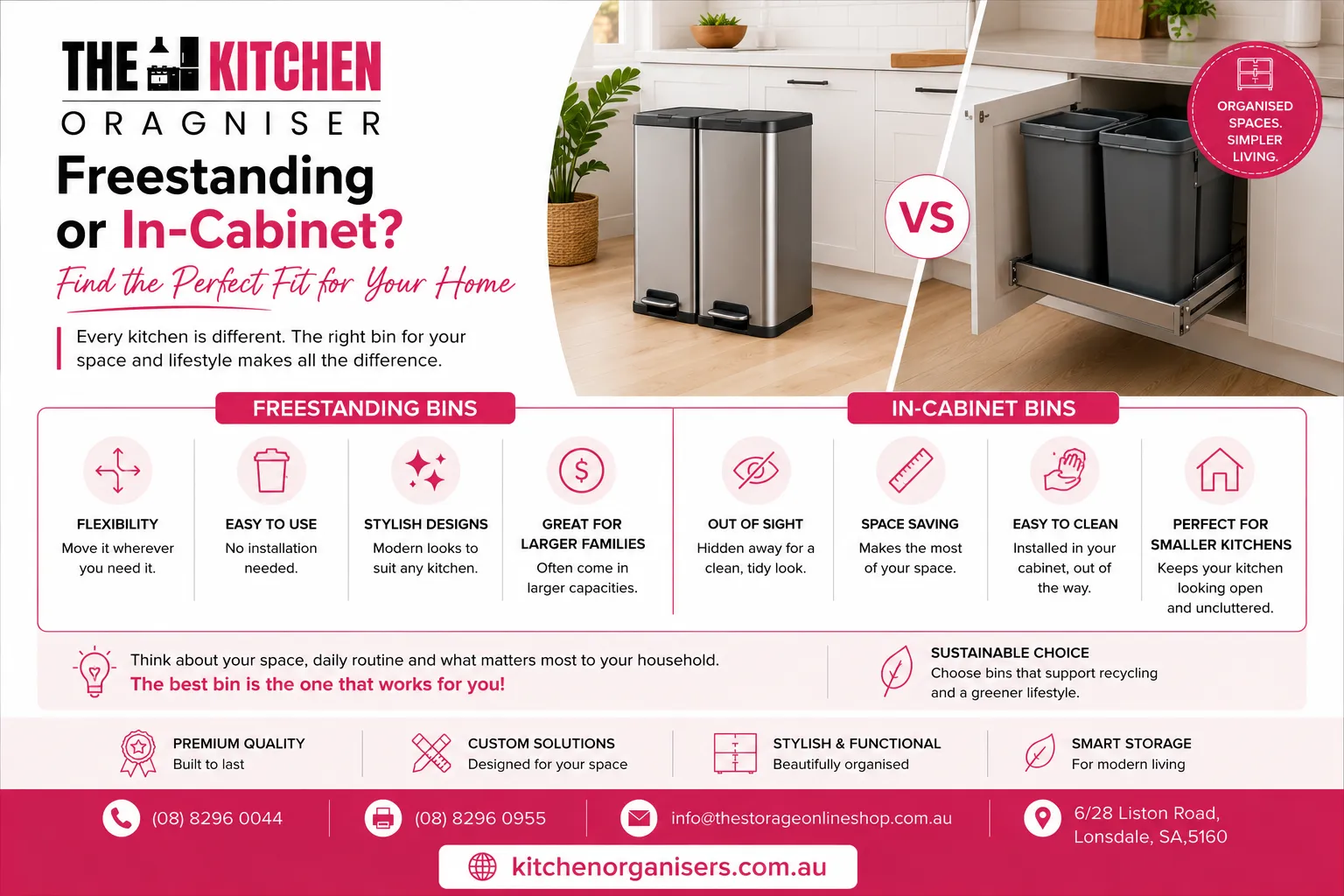
Freestanding kitchen rubbish bins are easy to position and generally need no installation. In-cabinet bins keep waste hidden and create a more streamlined kitchen.
Choose freestanding when: you have sufficient floor space, want a larger capacity, prefer not to modify cabinetry, need to move the bin for cleaning, or are renting and want something portable.
Choose in-cabinet when: you want waste hidden, floor space is limited, you prefer the bin near the preparation bench, or your cabinet has enough internal room for a pull-out or door-mounted system.
Some homes use both. A small in-cabinet bin collects general waste or food scraps, while a larger recycling container lives in a pantry, laundry or garage.
How Large Should a Kitchen Bin Be?
Large enough to hold your household’s typical daily waste, but not so large that rubbish sits indoors for too long.
Capacity depends on household size, cooking habits, packaging use and how often waste goes outside. Smaller bins suit one- or two-person households, apartments, food-scrap collection and secondary waste categories. Larger bins suit families, shared homes, frequent cooking and less frequent collection.
Don’t assume the biggest bin is automatically best. Oversized bins are harder to fit, lift and clean — and they encourage waste to linger in the kitchen.
Single, Double or Multi-Compartment
Waste separation is easier when each category has a clearly defined container.
A single-compartment bin gives maximum capacity for one waste stream, suitable where recycling and scraps are stored elsewhere. Double-compartment bins separate general rubbish and recycling in one location, reducing the need for multiple freestanding containers. Multi-compartment systems with three or more sections support general waste, mixed recycling and food scraps in a single cabinet.
Before choosing a divided system, consider how much each category actually produces. Equal compartments aren’t always practical — most households create more recycling than general waste, or only a small amount of food waste daily. The compartments should reflect real behaviour.
How Pull-Out Bins Work
Pull-out bins are installed on a frame or runner inside a cabinet. When the door or handle is opened, the bin slides forward for easier access.
This means containers at the back of a cabinet can be reached without bending and stretching inside the cupboard. Pull-out systems keep multiple compartments contained, hide waste when the cabinet is closed, and make it easier to remove individual buckets.
Check whether the system attaches to the cabinet base, sides or door — the method must suit your cabinet’s dimensions and construction. If you’re not confident installing sliding hardware, consider professional installation.
Features Worth Comparing
Kitchen bins can look similar, but small design differences affect daily use:
- Removable inner buckets — easier to empty, reline and clean.
- Secure handles — full buckets are easier to lift from a cabinet.
- Smooth sliding mechanism — runners should move steadily without excessive force.
- Easy-to-clean surfaces — complicated corners and narrow grooves trap residue.
- Suitable lids — check there’s enough clearance to open inside the cabinet.
- Liner compatibility — unusual shapes may require careful liner selection.
- Compartment capacity — compare each section individually, not just the system total.
How to Measure for In-Cabinet Bins
Accurate measuring is essential, because a bin can fit inside the cabinet but still fail to pass through the opening.
- Empty the cabinet.
- Measure the internal width at the narrowest point.
- Measure from the cabinet opening to the back wall.
- Measure the available height beneath shelves, sinks and pipes.
- Note the position of hinges and door hardware.
- Check whether plumbing reduces the usable depth.
- Allow space for the bin lid or sliding frame.
- Compare every measurement with the product specifications.
Don’t round measurements upward. A few millimetres matter, particularly when hinges or cabinet frames narrow the opening.
Common Mistakes
Choosing capacity without measuring — a large bin isn’t useful if it blocks pipes or stops the door closing.
Ignoring the cabinet opening — the internal cabinet may be wide while hinges create a much narrower entry.
Placing the bin too far from food preparation — an inconvenient location means scraps stay on the bench.
Creating too many waste categories — a complex system is confusing and eats cabinet space.
Blocking plumbing — an under-sink system shouldn’t make pipes, valves or filters unreachable.
Frequently Asked Questions
What are the best kitchen bins for a family?
A larger-capacity system with separate compartments for general waste and recycling. The exact size should reflect how much waste the household produces and how often bins are emptied.
Can a kitchen bin go under any sink?
Not always. The sink bowl, pipes, filters, hinges and cleaning supplies all reduce usable space. Measure the complete internal area first.
Are pull-out kitchen rubbish bins worth it?
Worthwhile when you want waste hidden inside a cabinet and need easy access to multiple containers. Most useful when the cabinet has adequate width, depth and height.
How do I stop an under-sink bin from smelling?
Empty it regularly, contain wet waste, wipe spills promptly and clean the removable bucket and cabinet area. Check for plumbing leaks — moisture beneath the sink creates odours too.
Can renters install an under sink bin?
Renters can use freestanding or removable options without permanently changing the cabinet. Permission may be needed for systems using screws or altering cabinetry.
Final Thoughts
The right bin system makes waste disposal feel like a natural part of using the kitchen rather than an inconvenient extra task.
Begin by deciding which waste categories your household needs. Then identify the most convenient location and measure the space carefully. Compare capacity, access, cleaning requirements and installation before deciding.
Whether you choose a freestanding bin, a pull-out system or a compact under-sink option, the best solution fits the kitchen and stays easy to use every day.
Good kitchen organisation isn’t about hiding as many containers as possible. It’s about creating a simple waste system that supports a cleaner, more functional home.