
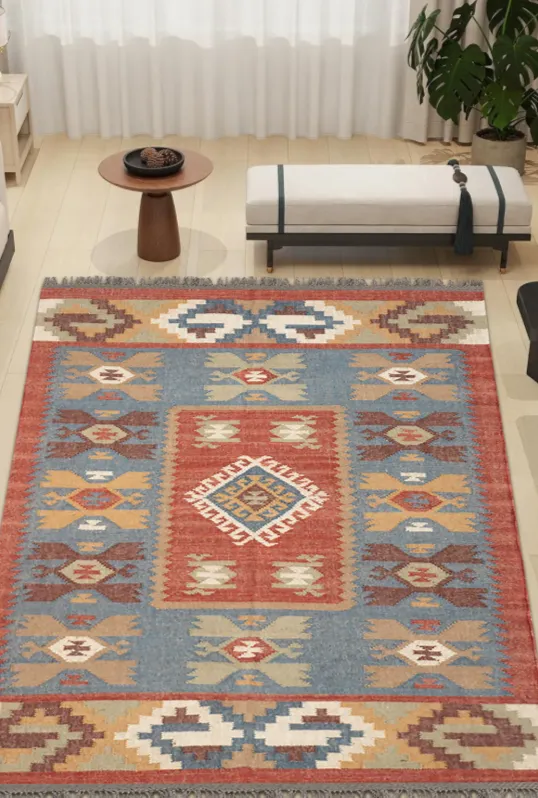
Buying a carpet for living room spaces always sounds easier than it actually is. You walk into a showroom, or open a dozen tabs, and somehow still end up unsure if you’re picking the right thing. Most people get stuck on the same few questions, so here they are, answered straight.
1. What size rug do I need?
Sizing trips people up the most. Go bigger than feels natural. A rug that’s too small just looks like it’s floating in the middle of the room. Aim for at least the front legs of your sofa and chairs resting on it. In most living rooms, rugs and carpets that work out (in most cases) are 6×9 ft, 8×10 ft, or 9×12 ft, depending on how much seating you’ve got.
2. Wool, cotton, or jute?
Each does something different. Wool rugs are the one most people end up with, and for good reason. The rugs resist stains, keep their shape, and actually look better as they age. Cotton rugs are lighter and cooler. They are one of the top picks for summer. Jute looks great but stains easily, so keep it away from where people are actually sitting and eating.
3. Is a handmade rug worth the extra cost?
Yes, and here’s why. A handmade rug is tighter in weave and built to age well instead of fall apart. A machine can churn out a uniform pattern in a day. A weaver puts in weeks, sometimes months, and that shows up ten years later. Choosing between a cheap synthetic piece you’ll replace in two years and a handmade wool rug that becomes part of the room for a decade — the math usually favours the second.
4. What colour works for a small living room?
If your living room is on the smaller side, go light. Cream, ivory, soft grey, these rugs don’t fight with the floor, they kind of blend into it, which makes the whole room feel like it stretches further than it actually does.
A dark, heavily patterned living room rug does the opposite. It sits there as its own block of colour and visually chops the floor into pieces, which is the last thing a small room needs.
Either way, it helps to think about it before you fall for a pattern — measure the room, figure out roughly how much floor will actually be visible around your furniture, and then decide if you want that floor to recede or stand out.
5. Should the rug match my sofa or my walls?
Neither, exactly. Think of it as a third element connecting the two. If your sofa and walls are fairly neutral, a rug with some pattern or colour can give the room personality. If your space already has a lot going on – patterned cushions, bold art, a quieter rug usually balances it out better than adding more pattern on top.
6. Do I need a rug pad underneath?
If your flooring is marble, tile, or polished wood, yes. It stops the carpet sliding once there’s foot traffic and furniture involved, adds cushioning, and protects the floor underneath. Small cost next to the rug itself — not really worth skipping.
7. How do I clean and maintain it?
Vacuuming covers most of it, honestly. The thing that actually matters is catching spills fast. Don’t let anything sit and soak in. If it’s a wool rug, blot it, don’t rub, and stay away from harsh chemical cleaners, they tend to strip out the natural fibres over time. Turning the rug around every few months isn’t a bad habit either, it keeps the wear even instead of one patch taking all the foot traffic.
8. Hand-knotted or hand-tufted — what’s the difference?
Hand-knotted rugs are tied one knot at a time on a loom. It’s slow work, which is exactly why these rugs end up so dense and durable. Some of them genuinely last generations if you look after them.
Hand-tufted rugs take a shortcut: a tufting gun pushes the yarn through a fabric backing, so they come together much faster. Still handmade, still decent quality, just not built for the same lifespan. If you can stretch the budget, a hand-knotted wool rug is usually the one you end up keeping for good instead of replacing in a few years.
9. Will a carpet work on marble or tiled floors?
Marble and tiled floors actually suit a carpet really well, sometimes even better than carpet over existing carpet. The only thing you shouldn’t skip is an anti-slip rug pad underneath, otherwise it’ll shift every time someone walks across it.
10. How do I know if a rug is genuinely handmade?
The easiest way to check is just flip the rug over. On a real hand-knotted carpet, the back shows almost the same pattern as the front, knot by knot, and the knots themselves are a little uneven. That’s not a defect, that’s actually what tells you it was made by hand and not a machine. A machine-made rug, on the other hand, has a flat, uniform backing with no knots, no texture, nothing to flip and check.
Where to start looking
If you’d rather skip the guesswork, Kesari Home’s collection of hand-knotted and hand-woven rugs is built around exactly these questions. We have right sized rugs for living rooms, wool and natural-fibre options, traditional, transitional, and modern styles depending on what your space needs. A good place to start if you want a carpet for living room that’s made to actually live in, not just look good in a photo.