
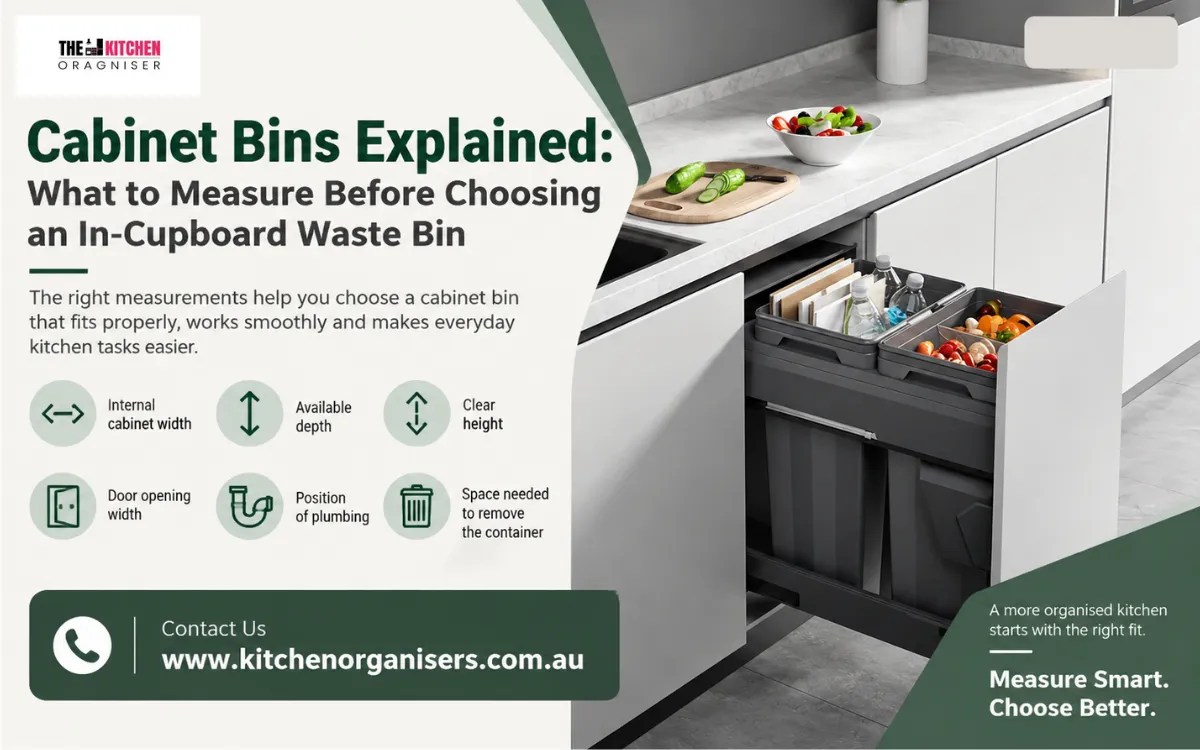
An in-cabinet waste system can look like a straightforward purchase until installation day reveals an inconvenient pipe, narrow door opening or lack of clearance. Kitchen cabinets come in many shapes and configurations, so the dimensions that matter are not limited to the space occupied by the container itself.
If you are considering a kitchen cupboard bin, careful measuring should happen before browsing specific models. A few minutes with a tape measure can help determine whether a container, frame or pull-out mechanism will work comfortably in the intended cabinet.
Begin With the Cabinet Interior
Open the cabinet completely and measure the usable internal space.
Do not measure only the outside dimensions of the cupboard. Cabinet walls, hinges, runners and plumbing can significantly reduce the actual area available for a waste container.
Record the following:
-
Internal width
-
Internal depth
-
Clear height
-
Door opening
-
Position of hinges
-
Position of plumbing or other obstacles
-
Distance from the cabinet floor to the underside of shelves
These measurements provide a more realistic picture of what can fit.
Width Is Only One Part of the Equation
People often focus on width because it is easy to compare. Depth can be equally important.
A cabinet may appear wide enough for a particular in cupboard bin, but the rear of the cabinet may be occupied by plumbing or other equipment. A container that extends too far backward could prevent the door from closing or interfere with other storage.
Measure from the front edge of the usable cabinet area to the furthest practical point at the back.
Check the Door Opening
A container needs to pass through the cabinet opening before it can reach its final position.
This is particularly relevant with larger containers. Even if the internal cabinet dimensions are generous, a narrow door opening can restrict installation or removal.
Measure at the Narrowest Point
Open the door to its normal maximum position and identify the narrowest passage through which the bin will need to move.
This is especially important if hinges or neighbouring panels reduce the opening.
Height Can Change the Choice
Vertical clearance deserves close attention.
A cupboard bin may need enough height for the container itself, plus space for the liner and any frame or mounting system. If the cabinet contains a shelf, water connection or other fixed feature, usable height may be reduced.
Measure the available height from the actual installation surface to the lowest obstruction.
Think About Removal, Not Just Installation
Imagine the bin is full and needs to be removed.
Can it be lifted without catching on the cabinet frame? Can the liner be tied and taken out without hitting the benchtop? Is there enough clearance to clean the base of the cabinet?
These practical questions are often more important than whether the container technically fits.
Understand How the Bin Will Move
Different cabinet waste solutions can operate differently. Some remain fixed inside the cabinet, while others may slide or pull forward.

A cupboard bin with a movement mechanism requires enough clearance for that movement.
Before choosing a system, determine whether the cabinet allows:
-
Forward travel
-
Full door opening
-
Access to the liner
-
Easy container removal
-
Clearance around handles and hinges
A movement path should be treated as part of the required dimensions.
Decide What Capacity You Actually Need
Size should also reflect household habits.
A single person who cooks occasionally may not need the same waste capacity as a large household that prepares meals every day. If waste is separated into multiple categories, individual containers may also need to be smaller.
Consider how often the household is prepared to empty the bin.
A larger container reduces emptying frequency but requires more cabinet space. Smaller containers can fit restricted spaces but may need more frequent attention.
Plan for Waste Separation
If recycling or food-scrap separation is part of your routine, think about the arrangement before choosing the bin.
Two containers may be more practical than one large container if different materials need to be separated. The available cabinet width may then determine which configuration is realistic.
Account for Plumbing Under the Sink
If the cabinet is located beneath a sink, plumbing becomes one of the most important measurement considerations.
Pipes can occupy the centre or rear of the cabinet and create an irregular usable area. Take photographs and measurements from several angles before ordering.
If the cabinet has a removable shelf, also check whether removing or repositioning it is permitted and practical.
Why Choose Us
KitchenOrganisers.com.au provides kitchen waste and organisation products for customers looking to make more effective use of their available cabinetry. Its kitchen bin range allows buyers to explore different configurations rather than treating every cabinet as though it has identical dimensions.
The benefit of approaching the purchase this way is practical: the cabinet is assessed first, and the product is then selected around the space.
That makes it easier to think about capacity, accessibility, installation requirements and everyday use together.
About Us
KitchenOrganisers.com.au specialises in practical kitchen organisation products, including solutions for waste storage and cupboard use. The product range is intended to help homeowners make better use of areas that can otherwise become difficult to organise.
For anyone planning an in-cabinet waste solution, careful measurement and an understanding of the kitchen’s existing layout are useful starting points.
The Tape Measure Is Your Best Starting Tool
A cabinet waste system should fit the kitchen, not simply fit the product description.
Before selecting a kitchen cupboard bin, record the cabinet’s internal dimensions, door opening, obstructions and movement space. Then compare those measurements with the requirements of the chosen system.
An in cupboard bin can provide a neat and convenient waste solution when the cabinet has been assessed properly. Taking the time to measure first can save the frustration of discovering that a cupboard bin fits on paper but not in the real kitchen.